Project
Study of the shear response in laminated structures made of composite material
Research challenge
The shear strength of FRPs remains one of the most difficult design properties to determine consistently. CORA advances a test methodology developed in COMMUL/BISHEAR and formalized in UNE 0074:2023, using a biaxial tension–compression (TC) test on symmetric ±45° cruciform laminates.
The project seeks to establish repeatability, compare the TC response with common standards, understand the mechanisms behind non-linear shear response and continue the path toward full standardization.
Main objectives
Accessibility & repeatability
Develop a fixture for TC tests in uniaxial machines and verify repeatability across different testing systems.
Comparison with standards
Contrast TC results against ±45° tension, Iosipescu and V-notched rail shear methods, with particular emphasis on large-strain response and shear strength.
Numerical interpretation
Use progressive damage and micro-scale models to connect apparent response, microdamage, matrix plasticity and fibre reorientation.
Standardization
Validate UNE 0074:2023 and generate the technical basis required to progress toward a complete standard.
Research continuity
The research sits within the COMES line on experimental and numerical characterization of composite materials, with continuity from COMMUL and BISHEAR and direct connections with RENO/CORA.
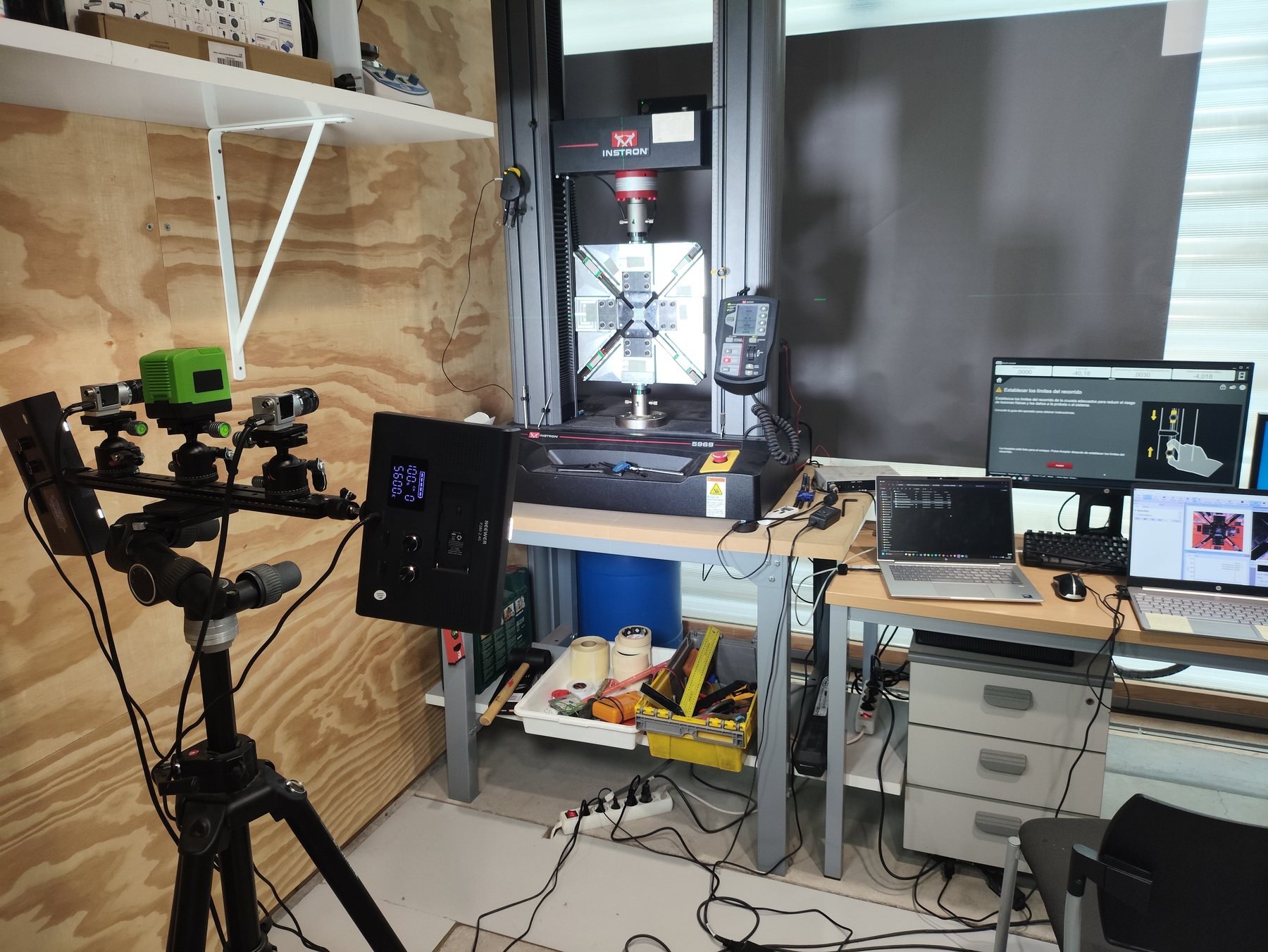
TC test with cruciform specimen
Equal-magnitude tension–compression loading of symmetric ±45° laminates enables the shear response in principal material directions to be studied while keeping the region of interest away from the grips.