Project
Shear-driven NOn-linear REsponse of composites considering biaxial loads and ionizing radiation effects
Research challenge
RENO addresses a central difficulty in the structural use of CFRPs: the apparent response can become strongly non-linear when it is governed by in-plane shear. Matrix plasticity and damage, fibre reorientation and multiaxial loading interact, while advanced aerospace applications may add degradation by ionising radiation.
The project combines biaxial experiments, Digital Image Correlation, standard shear testing and micromechanical modelling to determine not only peak properties but also the evolution of stiffness, damage and residual load-bearing capacity.
Main objectives
Pure shear characterization
Advance the TC test with cruciform specimens, compare it against standardized shear methods and make the methodology more accessible.
Biaxial response & stability
Understand non-linear effects in tensile–tensile and compression–compression tests and assess cruciform specimens for biaxial buckling studies.
Radiation & damage
Quantify how high-energy ionising radiation modifies CFRP stiffness, strength and the shear-driven non-linear response.
Micromechanics
Use coupled RVEs, cohesive interfaces and XFEM to connect crack initiation/propagation with apparent stiffness degradation.
Research continuity
The research sits within the COMES line on experimental and numerical characterization of composite materials, with continuity from COMMUL and BISHEAR and direct connections with RENO/CORA.
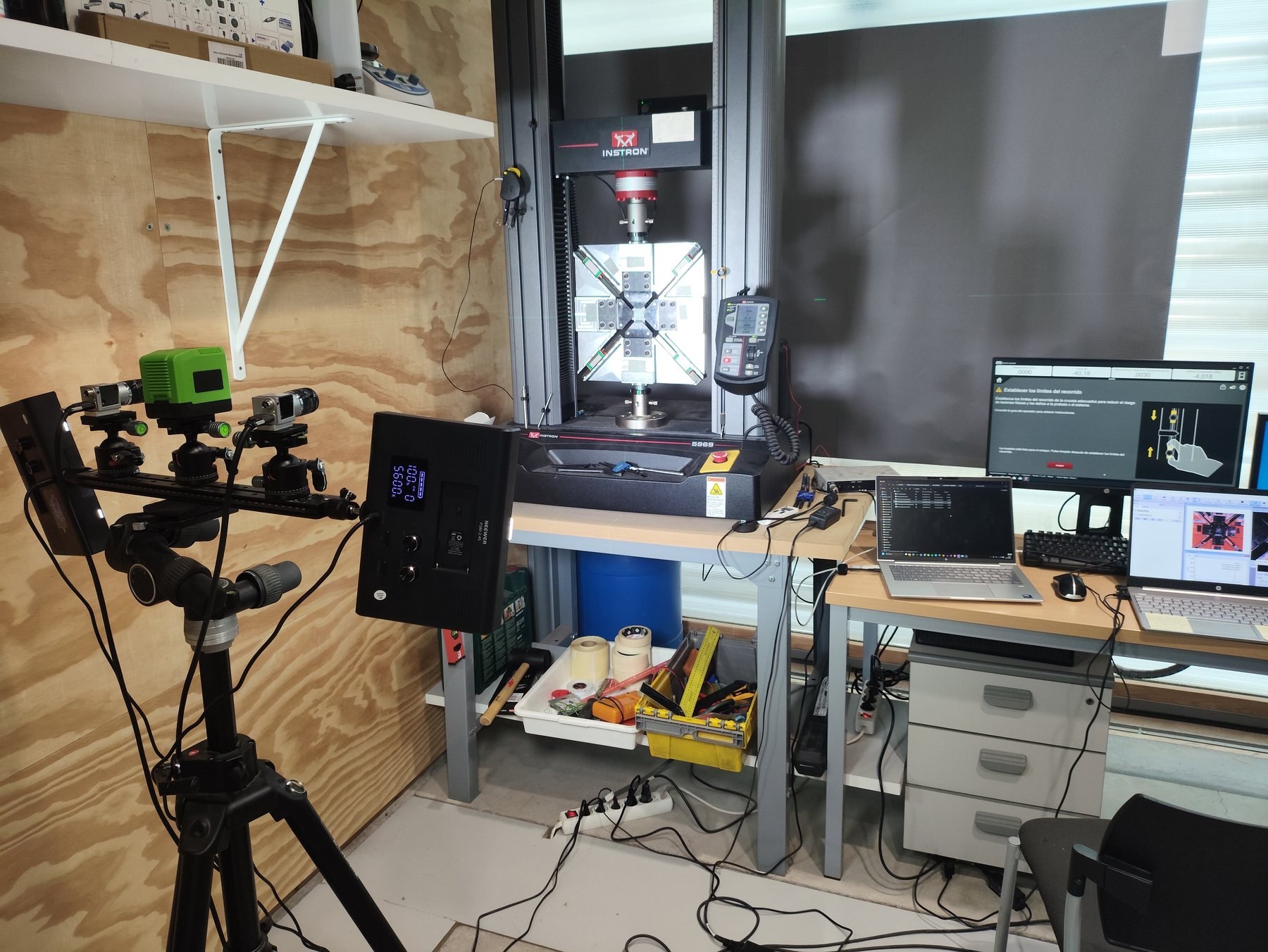
TC test with cruciform specimen
Equal-magnitude tension–compression loading of symmetric ±45° laminates enables the shear response in principal material directions to be studied while keeping the region of interest away from the grips.